A product prepared for Europe is not automatically ready for the United States or Australia. Each market has its own product rules, responsible parties, registrations, markings and evidence requirements.
ROBOMISE helps buyers review the compliance path for the markets they intend to enter, compare the available evidence with the actual product and organise the next actions with suppliers, laboratories and other qualified specialists.
Start a Project →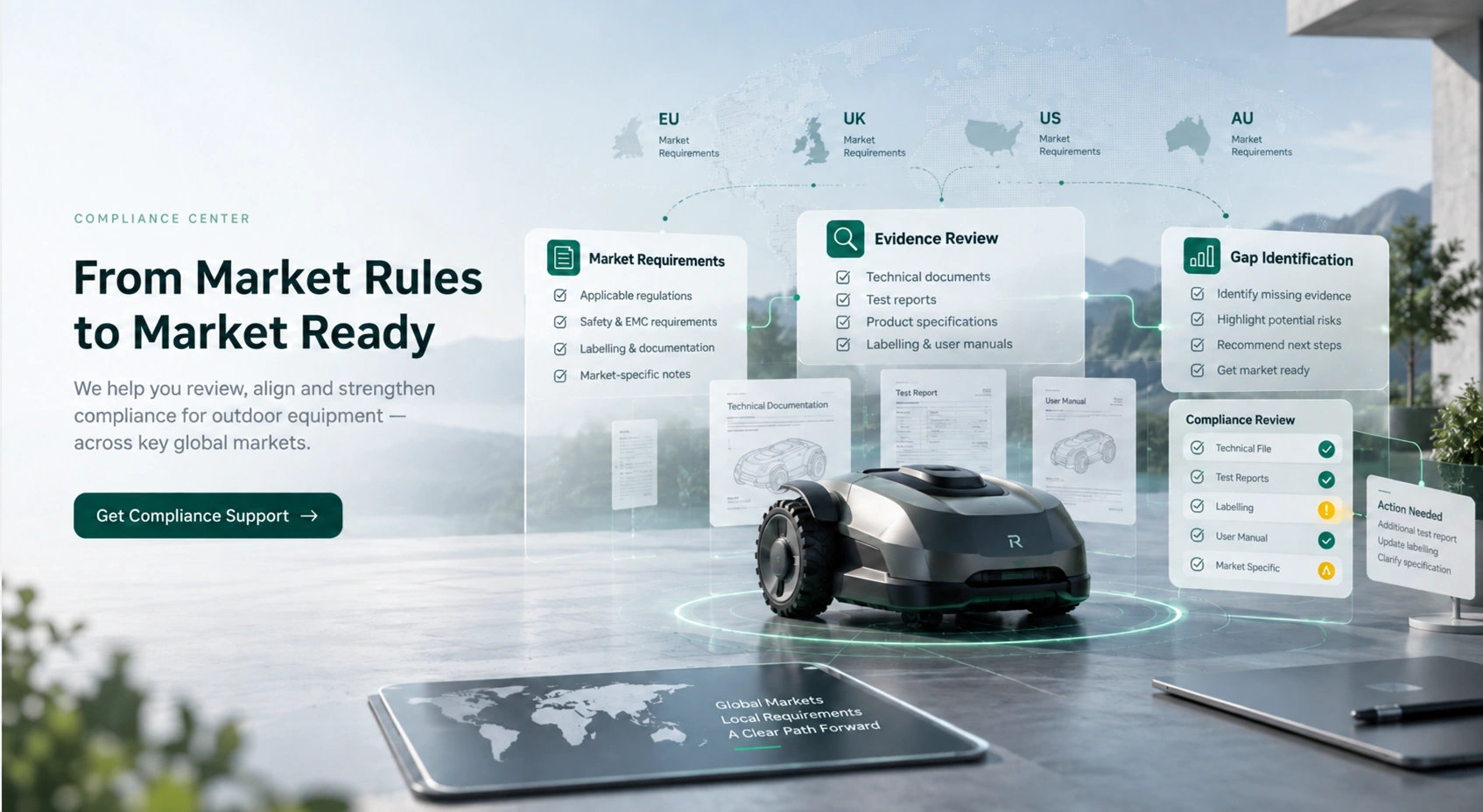
The same robotic mower, pool cleaner, pump, light or garden product can face a different route in each sales market. Product type, intended use, power source, connectivity, materials, accessories, claims and sales channel all affect the review.
The examples below show why a single certificate list is not enough. They are not universal checklists; the applicable requirements must be determined for the actual product and project.
For products sold in the European Union, the review may include the General Product Safety Regulation (GPSR), CE-related product legislation, technical documentation, risk information, traceability, labelling, the EU economic operator and producer-responsibility schemes.
Depending on the product, this can involve machinery, electrical safety, electromagnetic compatibility, radio equipment, restricted substances, batteries, WEEE and packaging obligations. GPSR addresses general product safety, traceability and the duties of businesses placing consumer products on the EU market. It does not replace product-specific legislation.
For buyers preparing GPSR compliance, the practical work starts with the product file, the responsible person arrangement and the evidence behind the declaration. We also check whether the EU responsible person arrangement matches the reality of the supply chain — not only whether a name and address are printed on the box.
The United Kingdom requires a separate market decision. CE recognition, UKCA requirements and producer registrations depend on the product sector and whether the product is placed on the market in Great Britain or Northern Ireland.
For a detailed GPSR compliance example, read our dedicated article.
The United States does not use one national CE-style route for all products. The compliance path may involve federal product-safety rules, FCC equipment authorisation for radio-frequency devices, electrical-safety certification requested by retailers or installation authorities, energy-efficiency requirements and state-level rules.
Depending on the product and claims, the review may include CPSC requirements and a General Certificate of Conformity, FCC Certification or Supplier's Declaration of Conformity, an NRTL mark such as UL or ETL, Department of Energy requirements, California Proposition 65 and rules affecting products that make sanitising or pesticidal claims.
Not every requirement applies to every product. The importer, private-label owner and the company named on a certification or filing must also be clear before the documents are treated as project evidence.
For electrical, electronic and connected products in Australia, the review may involve the Regulatory Compliance Mark, electrical-safety requirements under the EESS framework, ACMA requirements for electromagnetic compatibility or radio functions, and registration by an Australian responsible supplier.
Some products may also fall under GEMS energy-efficiency requirements. Pool pumps and certain lighting products require particular attention. WaterMark only applies to specified plumbing and drainage products, so it should be checked against the actual product rather than assumed for every pool or water-care item.
An RCM mark on a product is not enough on its own. The responsible supplier, product classification, registration, test evidence, declaration and compliance records must support its use.
A certificate can be useful evidence, but it does not answer every compliance question.
The buyer still needs to know:
Compliance is the connection between the actual product, the target market, the technical evidence and the companies responsible for placing it on that market.
Product evidence does not automatically prove that the supplier can maintain compliance in production. A management-system certificate does not prove that a particular product is market-ready either.
For the product, we look at the model, configuration, intended use, applicable market route, reports, declarations, markings, instructions and registrations.
For the production side, we look at whether the actual manufacturing entity and site are correctly identified, whether key documents can be traced to the production model, and whether changes to components, software and suppliers are controlled.
ISO 9001, ISO 14001, ISO 45001, SMETA, amfori BSCI or other company and site assessments may be relevant to the buyer or sales channel. They are not substitutes for product compliance, and they are not universal legal requirements for every project.
We organise the known safety, technical, environmental, labelling, documentation, registration and traceability questions for the agreed product and target markets.
We record the developer, actual manufacturer, brand owner, importer and local responsible party where relevant, and check consistency across product, packaging and documents.
We compare the available evidence with the proposed model and configuration, looking for consistent references, standards, dates and links between certificates and reports.
We check whether the available file explains the product, intended use, important components, identified hazards and supporting evidence at the right level.
We review whether required product and business information has been considered and whether markings, labels and instructions align with the target market and actual product.
We record which configuration the evidence relates to and which planned changes need confirmation, so a tested sample does not drift from the production model.
We assess whether the supplier can explain the product file, trace evidence to the actual model, respond to gaps and control revisions. Compliance readiness is part of supplier quality.
Depending on the agreed scope, the work may include:
A project-specific view of the intended markets, product configuration, business roles and main requirement areas that need to be addressed.
A comparison between the model planned for production and the reports, certificates, declarations, registrations and other evidence supplied for it.
A record of which company is expected to act as developer, manufacturer, brand owner, importer, economic operator or responsible supplier, and which registrations require local action.
A working list of missing, inconsistent or unclear items, with the next action, responsible party and decision affected.
When testing, certification or expert interpretation is needed, we organise the product facts, configuration and open questions so the external party receives a defined brief.
Deliverables are agreed for each project. Requirements and evidence depend on the product, configuration, target market, claims and role of each business involved.
Confirm the product, configuration, target markets, claims, business roles and timing.
Identify the applicable requirement areas, local registrations and evidence expected for the current decision stage.
Compare reports, certificates, declarations, registrations, markings and instructions with the proposed production model.
Ask the supplier for missing evidence, adjust the product or file, and involve a qualified laboratory, certification body or specialist where necessary.
Confirm that the approved configuration, manufacturing site, labels, packaging, registrations and document set still match production.
A robotic lawn mower may combine machinery, electrical, battery, radio and software-related questions. A robotic pool cleaner adds wet-environment use, charging and sealing considerations. Pool pumps may bring energy-efficiency requirements. Pool lighting, salt chlorination, hose systems and hand tools each follow a different product and evidence path.
A product with lithium batteries also brings transport-testing and shipping-document questions that sit alongside market-entry requirements.
We do not apply one certificate checklist to every category or reuse one market's answer for another. We connect the review to the actual product, target market and sourcing decision.
A supplier may have good production equipment and still have a weak product file. Another may have reports but no clear control over which configuration or factory was assessed. A developer may own the technical file while production is carried out by an independent contract manufacturer.
These are not only document problems. They affect whether the buyer can place, maintain and support the product in the intended market, and whether the evidence can survive a product change or supplier transition.
We therefore connect compliance work with supplier and product evaluation inside our broader Sourcing Services process.
Compliance asks whether the product, evidence and responsible parties meet applicable target-market requirements. FTO and IP screening asks whether commercialising the product may conflict with third-party rights.
A product can be compliant and still raise an IP concern. It can also have no obvious IP flag and still lack the evidence needed for its market. See FTO & IP Screening for the separate IP-risk process.
It is particularly useful when:
ROBOMISE is not a certification body, testing laboratory, law firm or regulatory authority. We do not issue certificates, approve products, provide formal legal opinions or guarantee regulatory acceptance.
Our role is to help the buyer define the scope, compare the actual product with the available evidence, identify gaps and coordinate the next actions. Testing conclusions, certification decisions and formal legal or regulatory opinions remain with the appropriately qualified organisations and professionals.
Tell us what you plan to source, the configuration you intend to sell, your target markets and what documents are already available. We will discuss where compliance support fits the project and which decision should come next.