Retractable Hose Reel Quality Control: From Sample Testing to Shipment Release
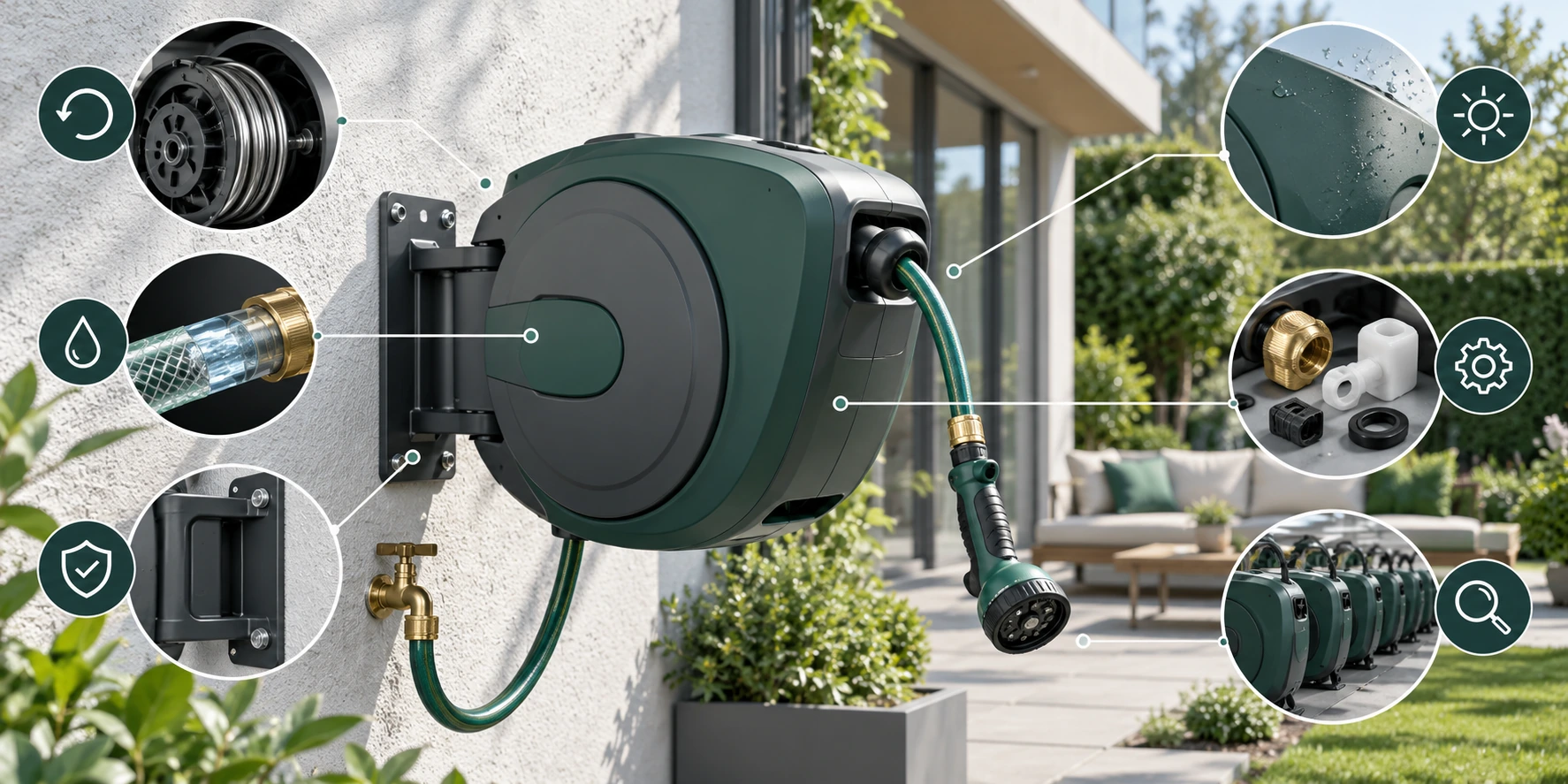
A retractable hose reel is easy to demonstrate. Pull out the hose, let the ratchet lock, release it and watch the hose return to its housing. A smooth demonstration is useful, but it leaves the importer with the harder question: will the next production lot behave the same way? This checklist deals with that quality-control question; it does not rank, shortlist or recommend individual suppliers.
Before placing a bulk order, check three things: whether the mechanism has been tested under defined conditions, whether the factory controls the components that affect performance, and whether the finished shipment can be compared with the approved sample. Ask for test records tied to the exact model and revision. A generic factory certificate or a video of a single smooth rewind does not answer those questions.
Start with the failures your customer would actually notice
Wall-mounted automatic hose reels combine moving mechanical parts, a pressurised water path and a support fixed to a building. They can fail in different ways. Treating all of them as a single “quality” score hides what needs testing.
| What can go wrong | What the buyer should request | When to hold approval |
|---|---|---|
| Hose fails to lock, retracts abruptly, or jams in the guide | A defined extension/lock/release/return protocol, test setup and results for the quoted hose length | The supplier shows only a short demo or cannot identify tested model/revision |
| Hose, swivel joint or fittings leak | Material/assembly specification and identified hydrostatic/leak tests, including relevant finished connections | Report concerns another hose or omits the actual fittings and connections |
| Reel or bracket cracks, shifts or pulls away from mounting | Bracket/housing design details, installation conditions, fixing instructions and load checks | “180° swivel” is offered as proof of mounting strength |
| Housing, hose jacket or exposed parts deteriorate outdoors | Weathering method, actual tested material/part, test conditions and measured property changes | UV hours are converted into an unsupported claim of years outdoors |
| Approved sample differs from shipment | BOM revision, controlled critical suppliers, change approvals and lot-level QC records | Critical parts changed without review or the production version cannot be identified |
This is a proposed buyer acceptance framework, not a claim that one particular factory has failed these checks.
1. Ask how the rewind mechanism was tested
Spring force alone does not determine whether a reel works well. Hose weight, guide friction, drum geometry, locking parts and a controlled-return device all affect how the hose extends and retracts. The test has to cover the assembly that will be sold, not only an isolated spring.
For the approved sample, have the supplier record the hose length and diameter, extension distance, mounting position, operating conditions and cycle procedure. Test locking and release at different extension positions, retraction from short and long extensions, even hose layering, and operation through the reel’s intended swivel range. Specify what constitutes a failed lock, a jam or an unacceptable return before testing starts.
For repeated-use testing, request the number of completed cycles, any failures and the functional checks performed afterward. An endurance claim without a test setup and acceptance limits is hard to reproduce. The buyer and supplier must agree project-specific limits; there is no single published cycle target established here for every retractable garden hose reel.
The safety issue is real. Hozelock tells users of its Auto Reel range not to open a faulty internal mechanism and warns against allowing the hose to return uncontrolled; its FAQ describes the relevant products as sealed against internal repair. Source: Auto Reel FAQs (Hozelock). GARDENA separately describes controlled retraction and an integrated hose guide for the named RollUp M model. Source: Wall-Mounted Hose Box RollUp M (GARDENA). These are useful design and safety examples, not proof of a different manufacturer’s product.
Buying decision: no identifiable specimen, procedure or failure criteria means the supplier has demonstrated an action, not validated repeatability.
2. Qualify the complete water path, not just the loose hose
The hose, rotating connection, seals, inlet fitting and outlet connector form one water path. A loose hose may pass a pressure test while the assembled reel still leaks at a joint or connection.
Ask for the hose construction and dimensions, intended working conditions, connector specifications, and a test report showing which assembly was tested. Match the supplied tap adapters and quick connectors against physical samples appropriate to each sales market. The words “universal connector” should trigger a compatibility check, not replace one.
ISO 1402:2021 specifies hydrostatic testing methods for rubber and plastics hoses and hose assemblies. Source: Rubber and plastics hoses and hose assemblies — Hydrostatic testing (ISO). It provides a basis for defining how to test; it is not a blanket statement of the correct working pressure or acceptance limit for every garden reel. Those values must come from the actual product specification and intended use.
If a leak appears, the record should identify its location: hose wall, hose-to-fitting connection, swivel joint or another part. That distinction determines whether a supplier has a hose-material problem, an assembly problem or a component-design problem.
3. Check the bracket and the outdoor-use claims separately
A wall-mounted reel carries the mass of its housing, hose and retained water while a user pulls from changing directions. Swivel angle is a product feature; it is not evidence that a bracket will hold on every wall. Ask for the intended mounting substrates, compatible fixings, installation instructions, and strength evidence covering bracket, pivot and attachment points under stated test conditions.
Weather claims require the same discipline. Which part was tested: housing resin, hose jacket, seal or printed label? What was measured after exposure? ASTM G154 addresses the operation of fluorescent ultraviolet and water exposure apparatus, and requires reporting the actual exposure conditions; the method alone does not establish a fixed number of outdoor service years. Source: ASTM G154 — UV Exposure Apparatus (ASTM International).
For Australia or other high-sun markets, ask for meaningful evidence on the exposed components. For frost-prone destinations, ask what the instructions say about draining water and what any frost-resistance claim covers. GARDENA publishes UV and frost-protection claims for identified RollUp products; do not transfer those claims to another SKU. Source: Wall-Mounted Hose Box RollUp M (GARDENA).
4. Find out who controls the specification
A supplier can assemble a reel without controlling the design of its spring cassette, ratchet, hose guide or seals. That is not necessarily a disqualification. The problem arises when nobody can explain who approves a change or owns the records needed to investigate a failure.
Ask for the current model identifier, critical bill of materials (BOM) revision, drawings or controlled specifications for the relevant subassemblies, and the list of components sourced from outside manufacturers. Trace one part through incoming inspection, assembly and finished-product checks. Ask who can authorise a replacement spring, hose compound, seal or plastic resin and how that decision reaches the buyer.
For an OEM or private-label project, the sample approval should cover more than appearance and packaging. Freeze the parts that determine safety, function and fit, alongside the visible styling. If a critical part changes, assess whether additional sample approval and targeted re-testing are needed before the next shipment.
5. Make the production lot answer to the approved sample
A sensible quality plan has different checks at different stages. Mixing them together leads to false reassurance.
| Stage | Decision it answers | Typical evidence |
|---|---|---|
| Design/sample qualification | Can the intended configuration meet the agreed requirements? | Reproducible mechanism and water-path testing; material and mounting evidence; approved sample identity |
| Production-process control | Is the factory still building that configuration consistently? | Incoming critical-part checks, BOM/change records, in-process controls and recorded functional checks |
| Pre-shipment lot inspection | Does the inspected lot match the agreed specification and acceptance plan? | Lot identity, random sample plan, observed defects, disposition and corrective action where required |
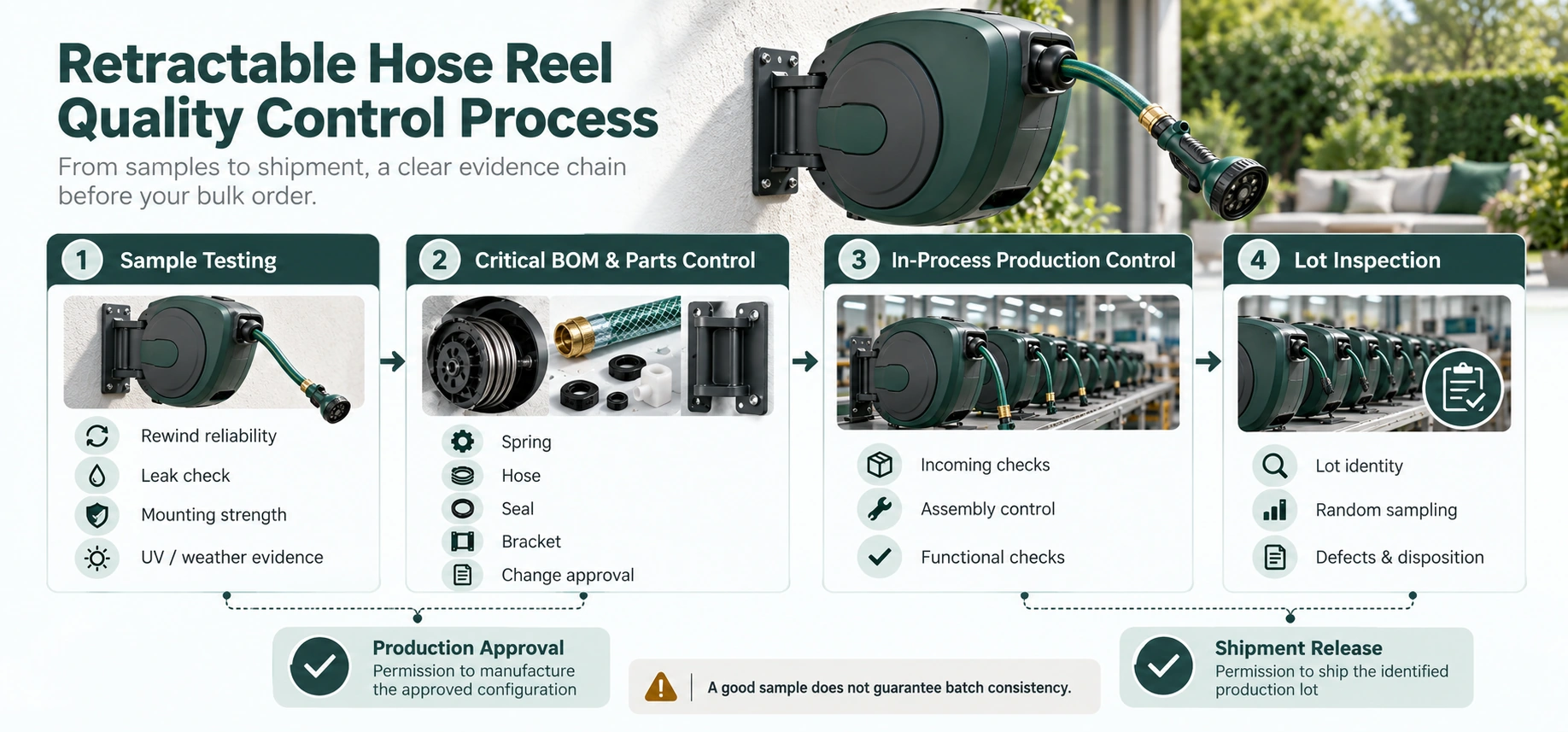
Where inspection by attributes is appropriate, the current ISO 2859-1:2026 provides an AQL-indexed system for lot-by-lot acceptance sampling. Source: ISO 2859-1:2026 — Sampling procedures for inspection by attributes (ISO). The buyer and supplier still need to agree the inspection level, defect definitions, lot formation, scheme and disposition rules. An AQL inspection cannot establish how many years a spring will last. Conversely, a successful endurance test of a few samples cannot prove that every reel in a shipment has been assembled correctly.
There are two separate approval gates. Production approval comes after the specification, critical BOM, signed sample and product-validation evidence have been reviewed. This gives the supplier permission to manufacture the agreed configuration, not automatic permission to ship. Shipment release comes later, when identified production lots have passed the agreed inspection plan, critical changes have been resolved, and nonconformities have a documented disposition.
Before booking shipment, reconcile the shipping model and revision with the tested sample and approved BOM. Investigate unexplained substitutions, failure records without disposition, missing traceability, or a sample selected solely by the supplier rather than through an agreed method. Where findings affect safety or core functionality, hold release until corrective action and the necessary re-inspection are documented.
6. Agree the repair and warranty boundary before printing the box
“Replaceable parts” is too broad to be useful. Ask what can be replaced safely by the consumer, what requires an authorised repair provider and what is treated as a sealed assembly. Confirm availability of hoses, couplings, nozzles, brackets and other agreed service items, including who holds the stock and how faults will be documented.
The service strategy varies by product design. For example, Hozelock’s Auto Reel FAQs describe sealed internal mechanisms that are not designed for internal servicing. Source: Auto Reel FAQs (Hozelock). That should prompt a private-label buyer to calculate the consequences of replacement versus repair, not to assume all models share the same policy.
7. Check destination-market safety evidence for the exact configuration
For EU consumer-market models, review the product-specific obligations under the General Product Safety Regulation (EU) 2023/988, including the safety analysis, technical documentation, relevant economic-operator duties and traceability. Source: Regulation (EU) 2023/988, Articles 9 and 11 (EUR-Lex). CE marking is not a default requirement for a purely mechanical hose reel; it is only required where applicable EU harmonisation legislation calls for it. Source: CE marking (European Commission, Your Europe).
For Australia, identify any applicable mandatory standard or product ban for the actual configuration, and evaluate general consumer-product safety obligations. Source: Product safety standards and how to comply (ACCC Product Safety); Source: Product safety responsibilities (ACCC). In the US, a CPSC General Certificate of Conformity (GCC) is required when the product is subject to a qualifying CPSC-enforced rule, not for every mechanical garden product. Source: GCC FAQ (CPSC). For imports that require CPSC certification, electronic filing of the certificate data took effect for most entries on July 8, 2026. Source: Certificates and eFiling update (CPSC).
Exact requirements depend on the product configuration, claims, intended users, destination and the entities placing it on the market. This is a short purchasing checkpoint; the broader EU process is covered in the site’s existing GPSR guide for garden and pool product importers.
Seven documents to request before production approval — and use again for shipment release
Send suppliers one list, not a request for every certificate in their office:
- Model and revision sheet: exact hose length, diameter, fittings, housing, bracket and intended markets.
- Critical BOM and change control: relevant part specifications, outsourced subassemblies and written substitution approval route.
- Rewind/lock test record: specimen identity, setup, cycle procedure, results, failures and disposition.
- Water-path test record: hose and assembly coverage, hydrostatic/leak method, connections and agreed pass criteria.
- Mounting and weather file: installation assumptions, bracket evidence and part-specific exposure results where claimed.
- Production and lot QC plan: incoming/functional checks, sample selection, defect classes, lot traceability and release authority.
- Market and after-sales file: instructions and safety information, relevant destination-market documentation, agreed spares and warranty-handling rules.
Approve production against a controlled design; release shipment against the actual lot. Both decisions must refer to the same model and revision. Missing evidence should trigger a specific document request, re-test or hold — not be concealed behind a longer warranty promise.
Questions buyers often ask
Does a successful sample demonstrate batch quality? No. It establishes something about that sample under its test conditions. Batch consistency requires controlled critical components, process records and inspection of identified production lots.
How many rewind cycles should a hose reel pass? There is no universal cycle figure substantiated for all models in this article. Define the intended duty, test configuration, pass/fail criteria and recorded results with the supplier before using a cycle claim.
Is a factory’s ISO 9001 certificate enough? No. A management-system certificate may inform a factory assessment, but it does not identify whether the quoted reel, hose, fittings and bracket have passed the relevant product checks.
Should every EU hose reel carry a CE mark? No. Determine which EU legislation applies to the actual configuration; do not treat CE as a blanket requirement for an ordinary purely mechanical hose reel.
A useful next step
If you are comparing OEM or private-label options, start with the wall-mounted retractable hose reel sourcing page. Include your destination markets, hose and connector configuration, branding/packaging needs, expected service model and the evidence already supplied by each factory. That gives a sourcing discussion something concrete to test, rather than another round of price comparisons.