Garden Hose Fittings Wholesale for Hose Reel Programs: How to Specify a Compatible OEM Kit
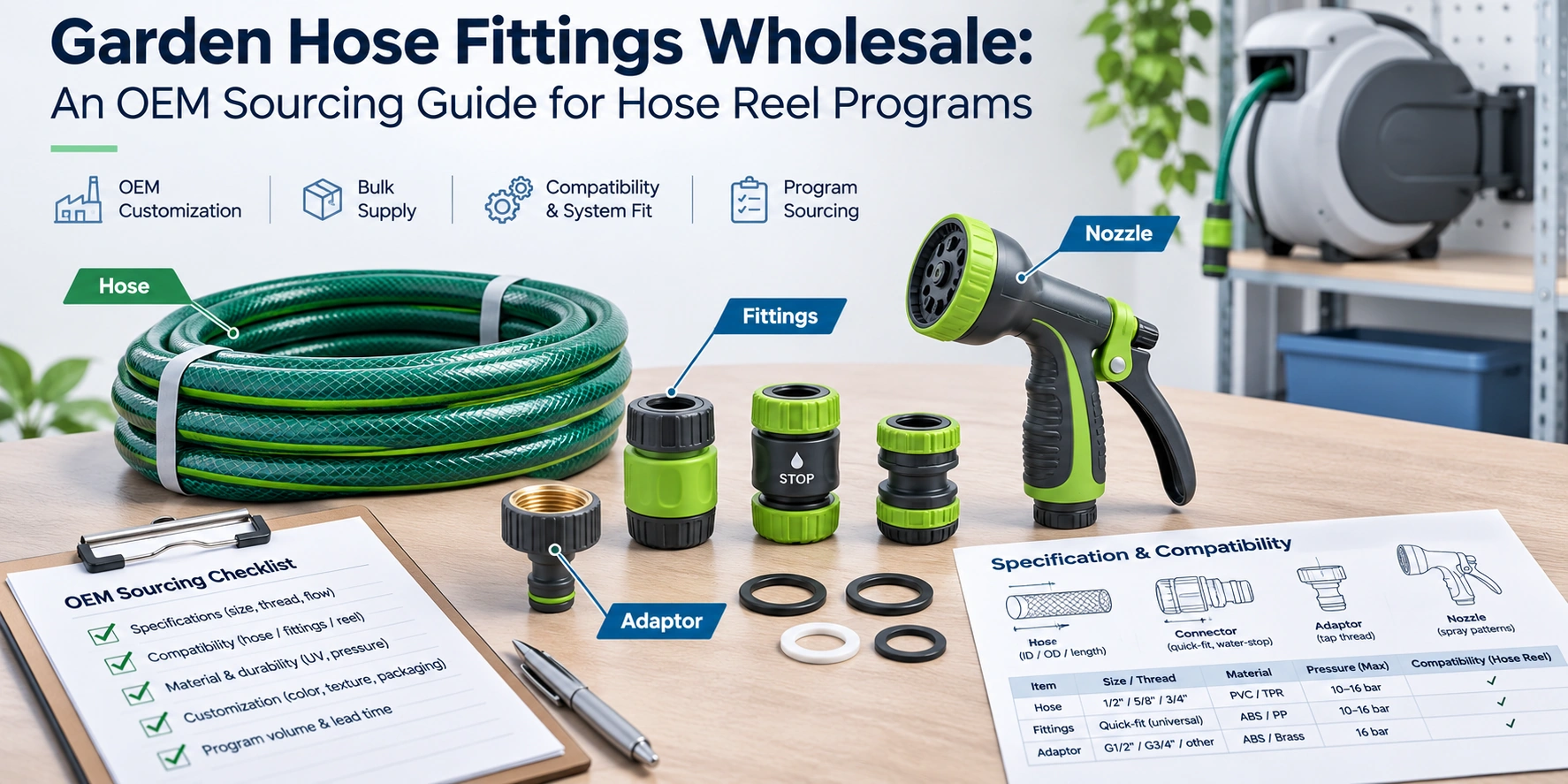
A retractable hose reel may be the headline product in a retailer's garden-watering range, but the customer uses a system: reel, hose, tap connector, hose-end fitting, spray nozzle and, sometimes, an adaptor. A catalogue can make these components look interchangeable. A landed shipment may prove otherwise.
For an importer or private-label brand, garden hose fittings wholesale is not simply a search for the lowest unit price. The commercial decision is whether separate suppliers can deliver a consistent, market-ready assortment without incompatible interfaces, fragmented minimum order quantities (MOQs) or unresolved quality claims.
Differing interface conventions between North America and Europe make this a procurement problem before it is a price question: a connector that suits one market's tap thread, hose diameter or quick-release family may not suit another, and the gap returns as local rework, rejected shipments or unsold inventory. Materials and sealing deserve the same caution, because low-temperature handling, pressure variation and repeated connection cycles have to be verified against the conditions the product will actually meet rather than against a catalogue description. Where the hose, fittings and nozzle come from different suppliers, compatibility and responsibility need to be agreed in writing before the first order is placed.
This guide focuses on the combination purchase: what to standardise, what to test and what to write into the RFQ before committing to a reel-and-accessory program. It is not a replacement for a retractable hose reel product-sourcing discussion or the hose reel production quality-control checklist.
1. Define the retail kit before asking for wholesale quotations
A manufacturer quoting a hose, a nozzle and a connector separately may be assuming three different products and three different packaging specifications. The buyer may need one coordinated retail system.
Start by defining the units the channel will actually sell:
| Commercial unit | Possible components | What the buyer must lock |
|---|---|---|
| Reel plus ready-to-use accessories | Retractable reel with its approved main/leader hose, tap adaptor, nozzle and instructions | Reel's fixed hose configuration, allowed connection points, retail box contents and country variants |
| Standalone garden hose | Hose with specified inner diameter, length and end fittings | Hose construction, working-pressure evidence, connection geometry and pack format |
| Hose fittings wholesale pack | Tap connectors, hose-end connectors, water-stop connectors, joiners and seals | Part numbers, hose-diameter range, mating interface, pack quantity and interchangeability claims |
| Spray nozzle and quick-connector set | Nozzle, approved quick-release fitting, compatible adaptor if required | Spray functions, user operation, click-on family and leak/retention performance |
| Replenishment or accessory assortment | Individually sellable fittings and nozzles | SKU/GTIN ownership, labelling, colour consistency, minimum reorder quantity and spare availability |
Do not assume every retractable reel accepts a replacement main hose. The reel's internal hose and spring/guide arrangement may be specific to its design. Accessories attached at the approved external interface are a different procurement question from altering a sealed reel mechanism.
A practical first RFQ should therefore include the target-market assortment drawing, not only pictures of attractive products.
2. Hose diameter, tap thread and quick-connect geometry are three different specifications
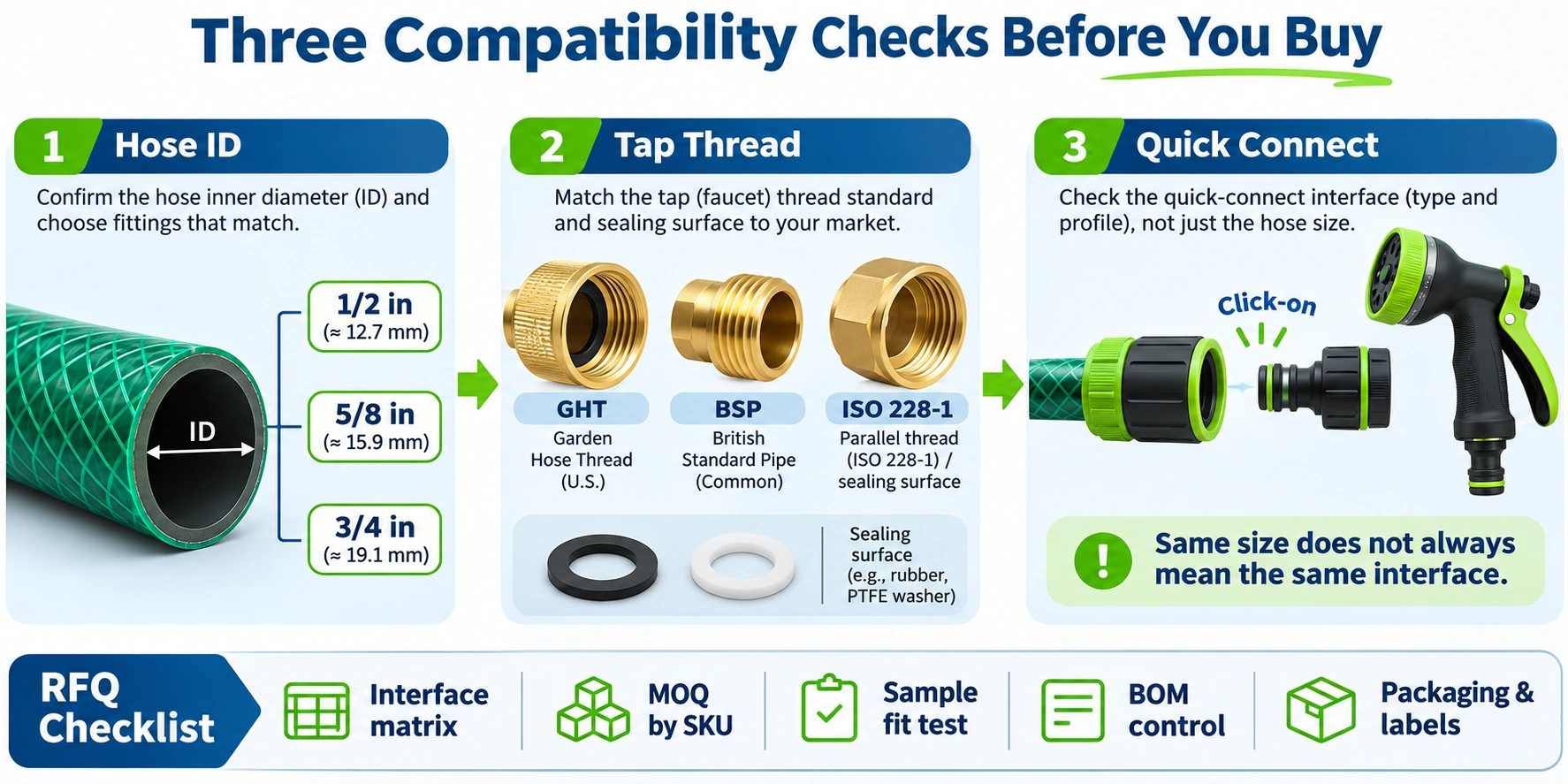
This is where mixed-supplier programs most often need a physical compatibility check. Three terms are routinely collapsed into the word “size”:
- Hose inner diameter determines which hose-end connector is intended to grip the hose.
- Tap or adaptor thread describes a threaded connection on a tap or accessory. A nominal fraction alone does not fully describe thread form or sealing method.
- Quick-connect interface describes the geometry of the click-on or proprietary coupling between accessories; matching hose diameter does not automatically prove two quick connectors mate correctly.
The distinction is visible in published product documentation. GARDENA offers one hose connector for 13 mm (1/2 in)–15 mm (5/8 in) hose and another for 19 mm (3/4 in) hose. Those are examples of manufacturer-specific product selections, not a promise that all garden-watering systems share an interface. Sources: GARDENA 13–15 mm connector and GARDENA 19 mm connector.
Hoselink's Australian compatibility guide distinguishes 12 mm residential, 14 mm model-specific Hi-Flow and 18 mm commercial fitting families. Hoselink also states that its proprietary connectors are not directly interchangeable with ordinary click-on accessories without the appropriate adaptor. These are descriptions of that company's systems, not national standards for every product. Source: Hoselink connectors and compatibility.
For a new program, the supplier must nominate the actual interface, not simply promise “universal compatibility.”
A market-by-market interface review
| Sales market / product example | Procurement question | Evidence to request |
|---|---|---|
| Australia: retail watering sets | Which hose ID and tap-thread variants are included? If a connector is proprietary, which adaptor is supplied? | Named target taps, actual hose-end and tap fittings, and completed mating/leak tests on the intended assortment |
| EU/UK: garden watering accessories | Is the proposed hose-end size consistent with the particular quick-connect family? What seals the threaded fitting? | Supplier drawings showing nominal thread designation, mating geometry, sealing surfaces and the finished kit |
| US/Canada: hose threaded accessories | Does the kit use garden hose coupling threads rather than a superficially similar plumbing connection? | Exact thread specification, physical gauges or a signed drawing, sealing washer detail and tested mating accessories |
For North American hose coupling threads, ASME B1.20.7 covers hose-coupling screw threads for hose connections; do not infer fit from a generic “3/4-inch thread” label. Source: ASME B1.20.7. For parallel pipe threads where sealing is achieved outside the threads, ISO 228-1 describes the thread requirements and notes the need for a separate seal where a pressure-tight assembly is required. Source: ISO 228-1:2000. These standards address different interface definitions; neither is a universal certification of a complete hose kit.
View full-size diagram (original illustration, opens in a new tab)
Buyer rule: obtain one signed interface matrix covering *every* intended hose, tap, connector and nozzle combination. Test the actual production-intent parts together, including adaptors.
3. Decide whether to buy one complete system or coordinate multiple factories
A buyer searching for a garden hose and fittings wholesale supplier in China may find specialists in hoses, moulded connectors, metal fittings and spray nozzles. That can increase choice, but it can also create a gap between component inspection and whole-kit responsibility.
There are three workable supply models:
Single-system supplier. One commercial counterparty supplies the reel-accessory bundle and owns the approved BOM, assembly compatibility and packaging. This simplifies accountability, but still requires evidence of which processes are performed in-house and which are subcontracted. “One invoice” does not prove “one factory.”
Multiple component suppliers under an importer-controlled BOM. The buyer can source the hose, fittings and nozzle separately while controlling the approved drawings, samples and final assortment. This is viable only if someone owns integration testing, corrective actions and change approval. Otherwise every supplier may blame another supplier's mating part.
Lead integrator with nominated component factories. One supplier or sourcing partner coordinates multiple component manufacturers against a single approved specification and dispatch plan. The importer should still have visibility of critical sub-suppliers and a defined way to approve replacements.
For each model, name a system owner in writing. This owner must be accountable for cross-component fit, configuration records, post-change samples and the remedy when mixed components do not work together.
4. A quote is not comparable until the same bill of materials is quoted
A low hose-fittings wholesale price can reflect a different resin, sealing component, metal finish, pack count or product configuration. Before comparing offers, use the same controlled bill of materials (BOM) and quote sheet for every candidate.
| Quotation line | Required specification | Common comparison trap |
|---|---|---|
| Hose | Construction, inner diameter, nominal length, application limits, colour and end termination | Comparing different hose grades or advertised rather than verified lengths |
| Hose-end connectors | Mating family, clamp method, approved hose size, material and seal | Assuming all click-on connectors mate with the selected nozzle |
| Tap adaptor | Thread designation, market variant, washer/seal and adaptor contents | Treating two nominal “3/4-inch” fittings as identical |
| Spray nozzle | Connection family, spray functions, body material, shut-off behaviour and packaging | Comparing a basic nozzle with a multi-pattern model |
| Retail pack | Exact count, artwork, language, barcode owner, carton quantity and spares | Comparing bulk loose fittings with individually packed retail-ready kits |
| Logistics and commercial terms | Incoterm and named place, currency, MOQ by SKU, sampling, tooling, inspection and replacement terms | Treating a blended MOQ or quoted FOB unit price as the total program cost |
Ask for MOQ by individual SKU, not just a headline order MOQ. A programme might meet the overall order value but still fail because one colour, hose length or nozzle variant has an uneconomic minimum. Quote the mixed-order plan with exact allocation by SKU and packaging variation.
The supplier should separately identify tooling ownership and artwork changes, which party buys labels, and which costs reappear on reorder. Compare the *landed and channel-ready* cost of the identical assortment, not only component FOB prices.
5. Sample approval must test complete kits, not isolated catalogue samples
A garden hose nozzle and quick connector OEM program can pass individual appearance checks and still leak, disconnect or prove difficult to use once assembled with another supplier's hose. For this reason, the approval sample should be a production-intent, retail-complete kit.
A minimum qualification plan should cover:
- Fit map: test each approved tap/adaptor, hose-end connector and nozzle combination; record failures by part number and revision.
- Leak and connection retention: agree test pressure, duration, sample count, acceptance criteria and end-use conditions *before* test execution. Do not borrow arbitrary pressure ratings from another product.
- Hose assembly evaluation: for rubber or plastics hoses and assemblies, ISO 1402:2021 provides hydrostatic testing methods, including dimensional stability measurement. The method's existence does not establish a pass/fail rating for this proposed SKU; the buyer and competent supplier must set justified requirements. Source: ISO 1402:2021.
- Use and handling: check that couplings connect and release as intended, nozzle patterns operate, and the hose is handled safely under the intended conditions.
- Outdoor exposure and materials: agree any UV, weathering, temperature and material verification relevant to the actual market and claims. Request reports tied to the submitted material and model; do not accept an unrelated generic certificate.
- Retail completeness: confirm packaging contents, instructions, warning information, barcode, model identity and correct adaptor variant in the box.
- Change control: require notice and fresh approval if the hose compound, fitting mould, seal, nozzle internals, hose-end geometry or sub-supplier changes.
Interface and sealing checks to add to the sample review
- Frost resistance and low-temperature suitability. Confirm the intended use climate, whether the product is drained or protected in cold weather, and which materials and test conditions support any cold-weather statement. "Frost-proof" is not something a catalogue image can establish.
- Sealing design. Ask for the seal type (O-ring, flat washer or moulded seat), the seal material, the tolerance of the mating parts, and evidence from repeated connect and disconnect cycles with the intended accessories.
- Thread compatibility. Separate garden-hose coupling threads from parallel pipe threads (for example GHT-type hose couplings and BSP parallel threads), and confirm the sealing method each relies on. Two fittings described by the same nominal fraction are not automatically compatible.
- Pressure testing. Test pressure, duration and acceptance criteria should follow the product's rated conditions and the applicable method; request the recorded result rather than a photograph of a gauge.
- Materials and regulatory scope. Applicable requirements depend on the target market and the actual product use. RoHS or California Proposition 65 should not be presented as a "lead-free certification" that every garden fitting must hold, and any lead-free claim needs evidence scoped to the parts and markets concerned.
Record what was tested, by whom, on which sample and revision. A photo of a pressure gauge is not a test report, and a statement that a hose is “heavy duty” does not define the performance threshold.
For the reel itself, refer to the existing retractable hose reel quality-control guide for sample-to-production and shipment-release controls. This fittings article addresses a separate approval: interoperability of the customer-facing kit.
6. Assign market documentation and quality responsibility before packaging approval
A private-label brand may combine components sourced from more than one manufacturer, but the final customer sees a single offer. The buyer needs a completed configuration record and market-appropriate documentation for that offer.
For products placed on the EU market, the General Product Safety Regulation (EU) 2023/988 includes obligations relevant to manufacturers, importers and other economic operators. The exact responsibilities depend on the product, parties' roles and applicable rules. It is not correct to assume that every garden hose connector requires a CE mark, or that a component manufacturer's generic statement resolves the finished-kit obligations. Source: Regulation (EU) 2023/988, Article 11.
For the United States, country-of-origin marking and claims also require care when components come from different locations. The FTC describes how foreign origin marking under CBP rules differs from advertising claims such as “Made in USA.” Source: FTC, Complying with the Made in USA Standard.
Before release, agree which party owns the final BOM, traceability, instructions, label artwork, claims substantiation, corrective action and any required market-specific documents. These items should follow the actual configuration shipped, not a generic catalogue image.
7. Seven items to send with a serious hose-and-fittings RFQ
A useful initial sourcing enquiry can be concise. Include:
- Destination markets and selling channels: for example AU retail, EU importers or US specialist distribution.
- Commercial assortment: reel bundle, standalone hose, connector retail pack, nozzle set or mixed-SKU program.
- Hose and connector interface sheet: hose IDs, lengths, tap threads, click-on family, any proprietary adaptors and proposed compatibility claims.
- Packaging brief: private-label artwork responsibilities, item counts, languages, barcode/GTIN allocation and master-carton configuration.
- Volume plan: initial quantity by SKU, target reorder cadence and target delivery window; ask for separate MOQ and tooling information.
- Evidence request: product drawings, BOM/revision identifiers, sample records, relevant test methods/results and specific factory/sub-supplier scope.
- Commercial responsibility: system integrator, nonconforming-kit remedy, component substitutions, spares and after-sales cost allocation.
A supplier that can answer these seven items in a structured way is easier to compare than one offering a single blended price with no interface or component records.
8. How Outdoor Equipment Partner can help structure the sourcing decision
For an importer adding garden-watering accessories to a retractable reel range, the first deliverable should be a compatible buying specification, not a stack of unrelated quotations.
ROBOMISE GLOBAL LIMITED, through Outdoor Equipment Partner, can discuss candidate supplier development, BOM alignment across categories, product-configuration review, initial compliance and IP/FTO risk screening, and the inspection evidence an importer should require. Any supplier qualification, testing, certification or legal conclusion must be verified for the actual project and product; none is implied by this article.
Source Compatible Garden Hose Fittings for Your OEM Program
Building a private-label garden watering range involves more than comparing individual component prices. Hose dimensions, tap threads, quick-connect interfaces, packaging and supplier responsibilities need to work together.
Outdoor Equipment Partner helps importers and brands explore suitable suppliers, align product specifications and coordinate sourcing requirements across hoses, fittings and accessories.
Start Your OEM Sourcing Project
Share your target market, required fittings, estimated order quantities and packaging needs. We can discuss supplier options, compatibility requirements, samples and the documentation needed before order approval. Start a Project or email info@robomise.com with the same brief.
If the order also includes the reel itself, the wall-mounted retractable hose reel sourcing page covers that product decision.
Questions procurement teams ask
Can we source the hose, nozzle and connectors from different Chinese suppliers?
Yes, as a procurement model, provided the importer or an appointed integrator controls the BOM, interface drawings, approved samples, quality criteria and responsibility for complete-kit failures. Supplier location alone does not demonstrate compatibility or quality.
Is a 3/4-inch tap fitting automatically compatible across Europe, Australia and North America?
No. The nominal size does not by itself confirm thread family, sealing surface or adaptor configuration. Verify the actual market specification and test mating samples. ASME B1.20.7 and ISO 228-1 address distinct thread contexts.
Does a standard garden hose quick connector work with every spray nozzle?
No. The intended hose diameter and quick-connect family both matter. Proprietary systems may require a dedicated adaptor, as published compatibility guides illustrate.
Should the supplier quote a complete kit or each accessory separately?
Request both a complete, retail-ready BOM quote and itemised component pricing where practical. Compare identical configurations, MOQ by SKU, packaging, lead times and the cost owner for any kit-level nonconformity.