
Why Robotic Pool Cleaners Perform Differently in Every Pool
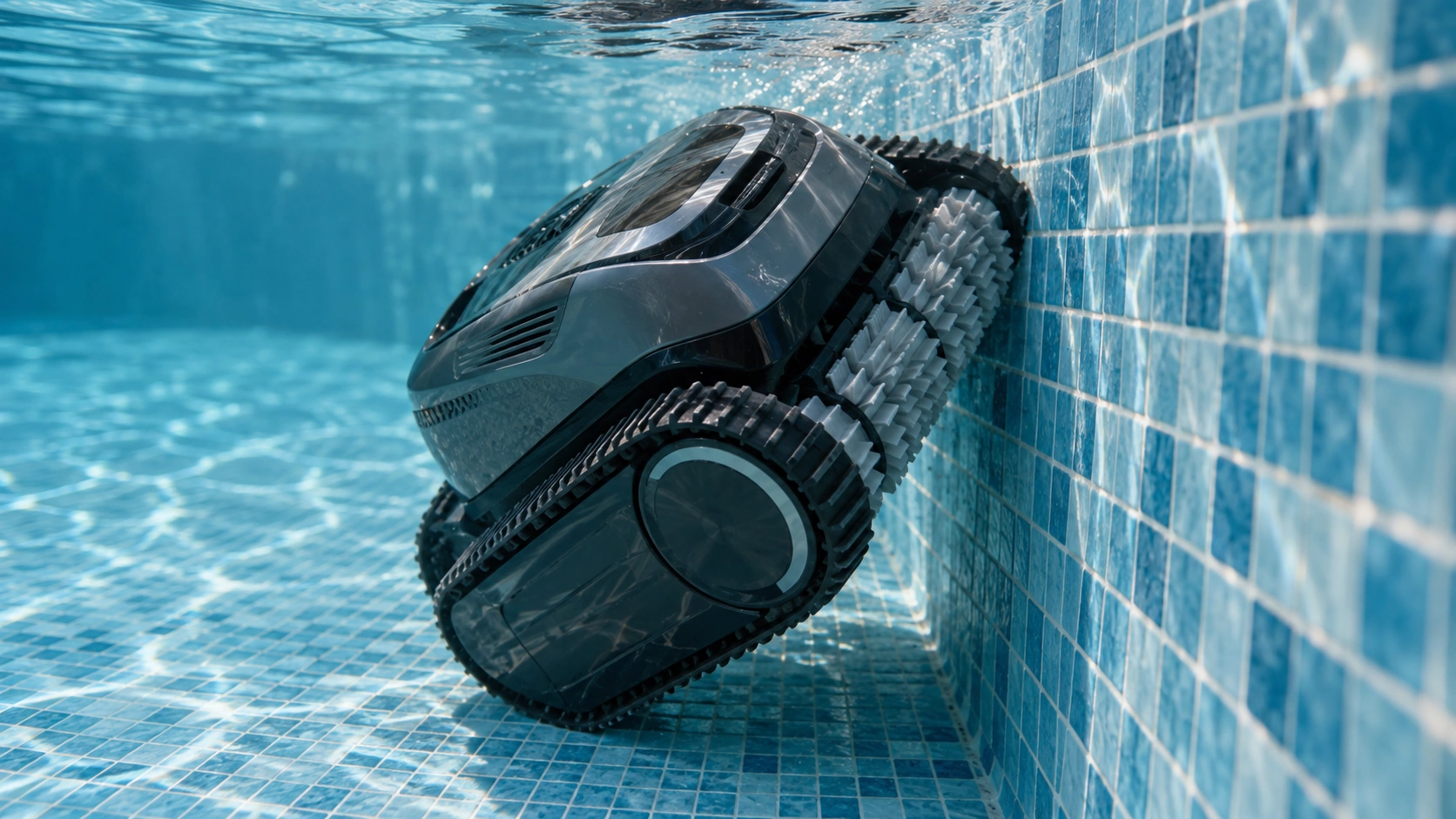
A pool cleaning robot that tests well in one pool can underperform badly in another. That is not a defect. It is what happens when navigation logic, mechanical design, and pool geometry meet conditions the factory never fully controlled.
Buyers who understand this get better test data from their suppliers and fewer surprises after the container arrives. This article covers what actually drives performance differences and how to ask for evidence that reflects them. It pairs with our earlier piece on evaluating a Chinese robotic pool cleaner manufacturer.
The demo pool is the least useful test
Most factories test in a flat, rectangular, plaster-lined pool. Some test in a small above-ground unit. Both tell you whether the machine works at all. Neither tells you how it behaves in the pool it will actually live in.
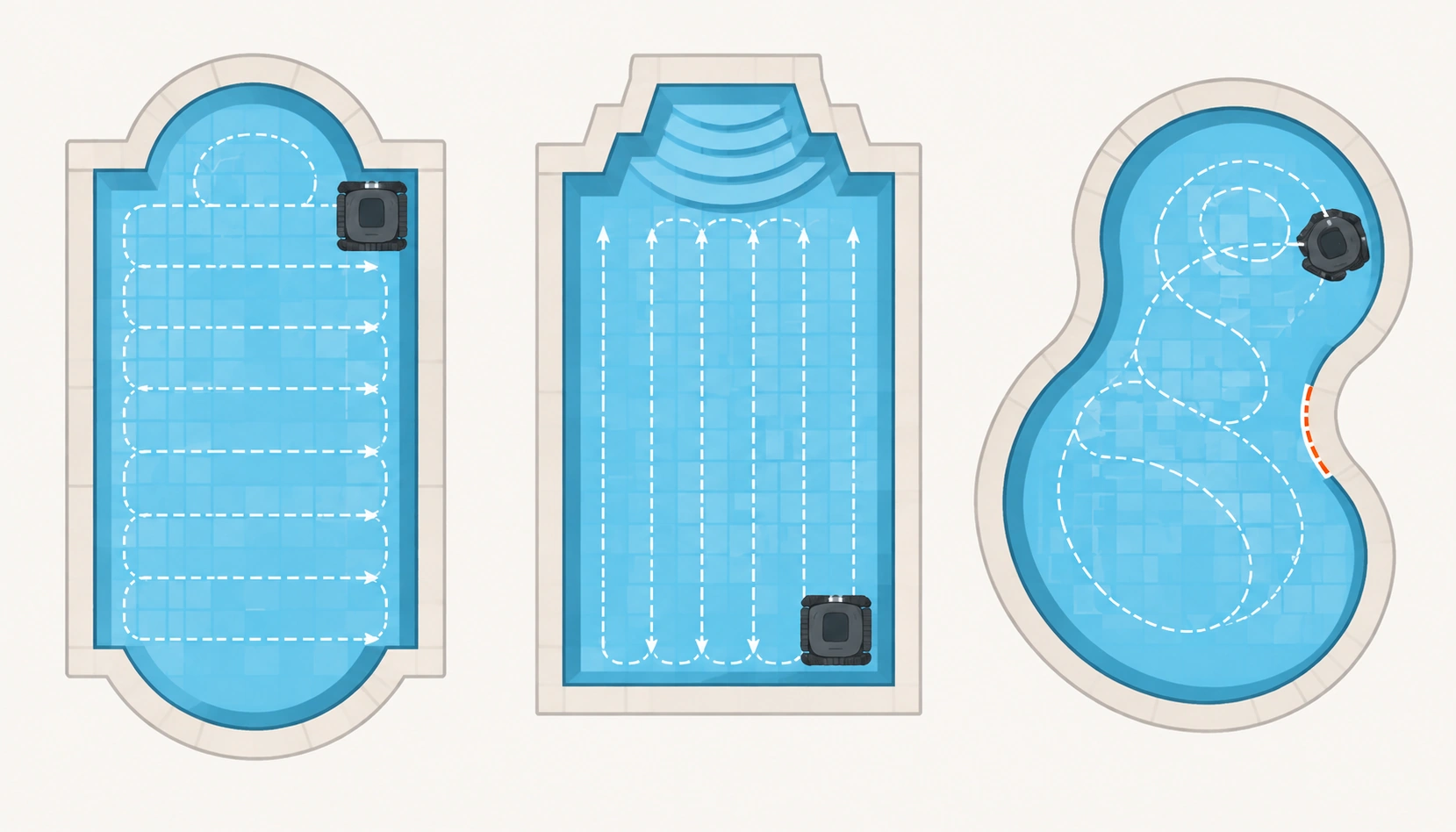
Real pools vary along at least five dimensions that matter to navigation and cleaning.
Shape. Rectangles are easy. Kidney, L-shape, freeform, and infinity-edge pools break the assumptions most path-planning algorithms are built on.
Surface. Plaster, vinyl, fiberglass, and tile all offer different friction. A robot that climbs a plaster wall confidently can spin on vinyl or slip on tile.
Slope and transitions. A sloped floor into a vertical wall is a different problem than a flat floor into a ninety-degree corner. The transition is where most machines fail.
Waterline. Tile line, stone coping, and dirty waterlines all need different behavior. A robot that ignores the waterline leaves the most visible dirt behind.
Obstacles. Main drains, lights, ladder rails, steps, and ledges. Each one is a place where the machine can get stuck, or where the cleaning pattern can leave a gap.
A test that covers one or two of these dimensions is not really a test. It is a demo, and the data from it rarely survives contact with a real pool.
In Spain, more than 60% of residential pools have tiled surfaces. Several robotic pool cleaner models have failed to climb the walls there, because tile offers much less friction than concrete. The brush-to-wall contact is what allows a pool robot to tilt up and start climbing. Some brands have redesigned the buoyancy system specifically for the Spanish market. Not every manufacturer has that awareness, or the experience behind it.
Before and after: a sand-cleaning demonstration
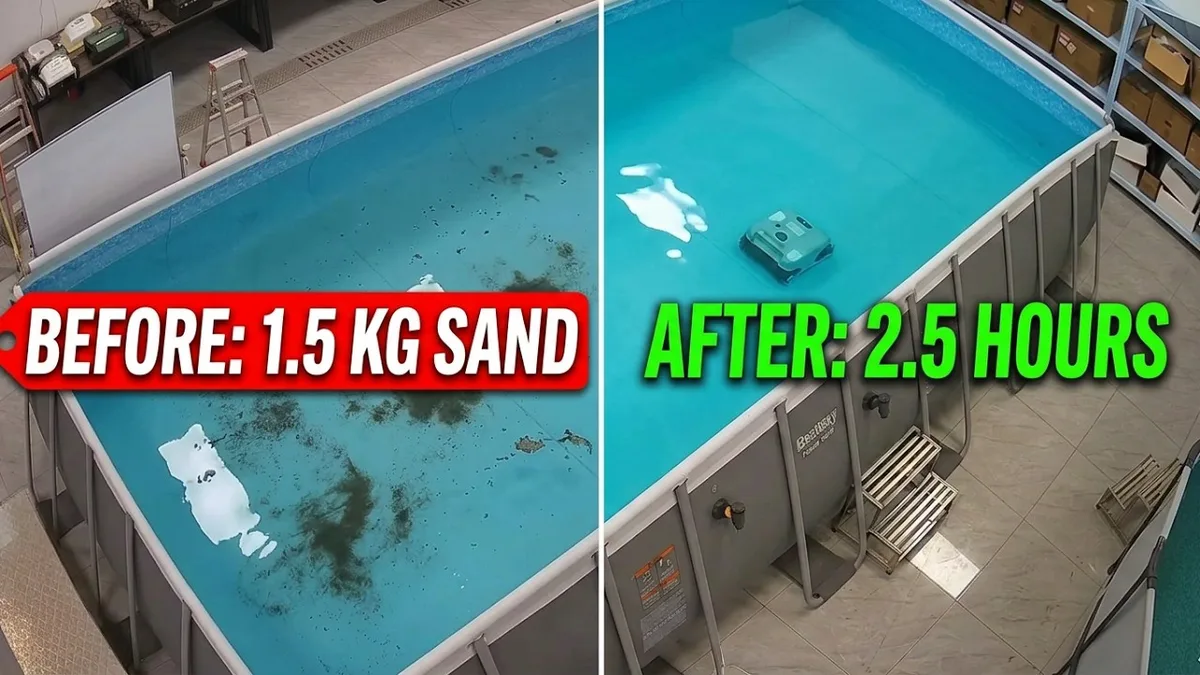
This time-compressed video from Outdoor Equipment Partner shows a before-and-after sand-cleaning demonstration in a single above-ground pool. Sand is visible on the floor before cleaning; by the end of the edited footage, the visible pool floor appears substantially cleaner.
Playing this video loads content from YouTube, which may receive information about your visit. Watch on YouTube
This is a visual demonstration, not a controlled or independently measured performance test. The video alone cannot establish a cleaning percentage, an independently verified cleaning time, or repeatable results across different pool shapes and surfaces.
- Watch the actual floor and edges, not just whether the water looks clear.
- Ask for the debris type and amount, filtration conditions, cleaning passes, and any other interventions.
- Request repeatable tests across different pool shapes and surfaces, with measured coverage and residual debris.
Video published by Outdoor Equipment Partner on YouTube. A third-party pool brand visible in the footage is not a partnership or endorsement.
For more on evaluating supplier test practices, read How to Evaluate a Chinese Robotic Pool Cleaner Manufacturer, or submit your OEM/ODM requirements via Start a Project.
Where performance actually comes from
Three systems determine whether a robotic pool cleaner will perform well in a given pool.
1. The navigation algorithm. Some robots map the pool and plan a path. Some run fixed routines and react to obstacles. Some do a mix. The difference shows up on irregular shapes and near obstacles, where a mapped path can be re-planned but a fixed routine cannot.
2. The mechanical design of the drivetrain. Tracked and wheeled robots behave differently on slopes, on steps, and at wall transitions. Brush design determines whether fine debris and larger leaves both get picked up. The size and layout of the filter basket determines how often the machine has to be emptied, which in a real pool matters more than the spec sheet suggests.
3. The firmware, and how often it is updated. A pool cleaning robot sold with one firmware version and never updated will not benefit from any of the improvements the factory makes after launch. A machine with an OTA update (Wikipedia, general term reference) path can be improved in the field. This matters more than most buyers expect on day one, and much more by year two.
What a useful test protocol looks like
If a manufacturer wants to prove a robotic pool cleaner performs across real conditions, the test protocol should cover:
- At least two pool shapes, ideally one irregular
- At least two surface types
- A sloped floor into a vertical wall transition
- The waterline
- Obstacles: a main drain, a step, and one fixed object such as a ladder rail
- Measured results: cleaning coverage, time to complete, battery cycles used on cordless models, and observed failure events
The protocol should be documented. Not "we tested on all pool types," but a written method with repeatable conditions. If the factory cannot produce it, it does not have one.
What to ask before you commit
Bring these questions to the supplier call.
- What pool geometries does your standard test protocol cover?
- Do you test on vinyl, plaster, fiberglass, and tile?
- How does the robot handle a sloped floor into a vertical wall?
- What does it do at the waterline?
- What happens when it encounters a step or a ledge?
- How is the firmware updated after sale, and how often?
- Can we run a joint test at a third-party facility before production?
A supplier that can answer all seven has a real test culture. A supplier that answers two or three is running a sales process, not an engineering one.
Why this matters for your margins
The cost of a pool robot does not end at the FOB price. A machine that performs well in the demo pool but poorly in the customer's pool generates returns, replacement shipments, and support tickets. Those costs land on you, not on the factory.
Testing across real conditions before you commit is the cheapest protection you have.
If you need help evaluating a robotic pool cleaner manufacturer or running a joint test before production, see our Robotic Pool Cleaner sourcing page or Start a Project.