Robotic Pool Cleaner & Lawn Mower Firmware, App and Cloud Ownership: What Importers Should Verify Before the First Order
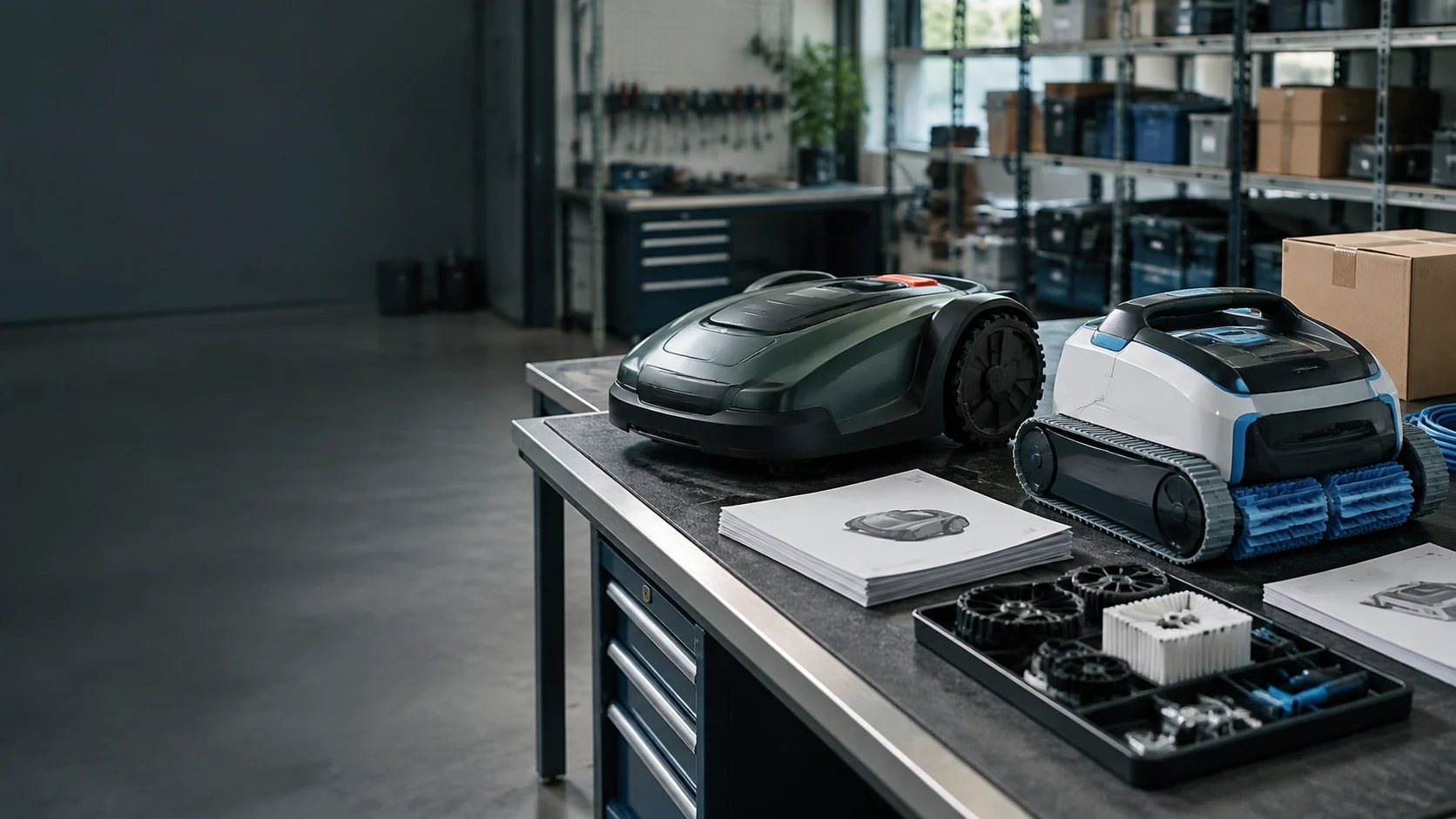
Direct answer. Before placing a first order for a robotic pool cleaner or robotic lawn mower, treat the software and connected services as part of the product you are buying. Confirm who controls the firmware, who operates the app and cloud account, what the machine can do without a connection, which version will ship, how an account-bound unit can be transferred, and what spare parts and diagnostic support will be available during the period you plan to support the product.
A machine can perform well in a factory demonstration and still become difficult to update, repair or transfer after it reaches a dealer or end user. Those are separate questions from cleaning or cutting performance, and they should be answered before the deposit.
There is a useful cross-category example. Neato is a robot-vacuum brand, not a pool-cleaner or mower brand. In its 6 October 2025 announcement, Neato said it was phasing out its cloud services after its operations had ceased in 2023. The announcement said the robots would continue to function manually and that warranty commitments remained intact. This does not tell us how an outdoor robot will behave. It shows why a buyer should ask what remains usable if a connected service changes or ends.
1. Separate the four things people call “the software”
Suppliers and buyers sometimes use “software” to mean several different things. Separate them before negotiating:
- Firmware — code running on the device, such as motion control, sensors, battery management and cleaning or cutting logic.
- The app and account — the phone-side interface, the user login and the process that binds a device to an owner.
- Cloud services — remote control, telemetry, maps, notifications, remote diagnostics and, in some products, the update channel.
- Data — coverage maps, usage logs, error history and account-level records.
One supplier may control all four layers; another may supply only the hardware and firmware while a separate platform provider runs the app and cloud. For example, Oso Robotics describes an OEM model in which its platform provides software, cloud dashboards, remote diagnostics and OTA updates while the equipment brand focuses on its own market and customer relationship. That is an example of a commercial model, not proof that every OEM supplier works this way.
Firmware ownership is not the same as the right to use a service. For an importer, app and cloud dependency are separate checks. Ask who owns the intellectual property, who has the right to operate and license each service, who can change or discontinue it, and what happens to customer data when the relationship ends.
Buyers evaluating robotic pool cleaners and robotic lawn mowers should request answers for the exact model and app they intend to sell—not a general statement about the supplier’s product range.
2. What still works when the connection fails?
“Connected” and “dependent on the cloud” are not the same thing. The difference affects customer complaints, returns and the work a dealer may need to do.
Husqvarna’s support documentation for connected Automower models says that when a mower loses its mobile network connection, it continues operating according to its schedule. Bluetooth control may remain available within about 30 metres, and models that support both mobile and Wi-Fi connectivity may switch to Wi-Fi. The mower cannot communicate with Husqvarna Cloud over the lost mobile link, and smart-home commands sent during the outage are not saved.
That document describes a specific connection-loss scenario for supported models. It is not proof that every mower will behave the same way when all internet access is unavailable, or when a cloud service itself is discontinued.
For a pool cleaner, the same questions should be answered separately. Do not assume that a robot can complete a cleaning cycle, retain its settings or accept local commands simply because it can operate when the Wi-Fi signal is weak.
Ask each candidate supplier to answer these questions in writing for the exact SKU:
- Which functions run locally on the device, and which require a live connection?
- Can the device start and complete its normal task when it has no internet connection?
- Is there a local control or recovery path when the cloud is unavailable?
- What happens to maps, schedules and settings if the account is deleted or transferred?
- If the cloud service ends, can the device still perform its core task, and can the user export relevant data?
A clear answer should describe the behaviour of the specific model, not just say “the product supports offline use.”
3. Version control: what does “the same model” mean?
Two units carrying the same model name may have different firmware versions, board revisions or configuration data. That can affect approval samples, spare-part compatibility and troubleshooting across a shipment.
Public firmware notes are one useful source of evidence. For example, Husqvarna publishes model-specific release notes and identifies the versions and changes covered. The notes also state that some updates are recommended rather than mandatory. That makes it important to record the shipped version rather than assuming every unit will be updated in the same way.
Pool-cleaner buyers should ask equally specific questions. In its instructions for certain iGarden Pool Cleaner K/KN models, iGarden says the OTA update is initiated through its app and requires a stable Wi-Fi connection. The robot must be on land during the update, and the phone should remain close to it. The instructions describe a process that takes about ten minutes, with the robot restarting during the process; pairing may be needed again afterward. They also describe a support recovery path using the device’s Virtual ID if an update does not complete normally.
Those are instructions for the named models, not a rule for every pool cleaner. They illustrate the level of model-specific documentation an importer should request.
For the first order, ask for and retain:
| Item | What to ask for | Useful evidence |
|---|---|---|
| Firmware baseline | Version shipped for each SKU | Version-screen image and a batch or serial-range record |
| Update channel | OTA, USB, dealer tool or no field update | Written method for each model |
| Recovery and rollback | What happens after a failed update; whether rollback is supported | Recovery procedure or a clear statement that rollback is unavailable |
| Maps and configuration | Where settings are stored and whether they can be exported | Written data-flow description and export instructions |
| Change history | Release notes and version history | Public or supplier-provided release notes |
If rollback is not supported, that is not automatically a reason to reject the product. It does change how you plan the pilot batch, how you record versions and how you handle a failed update.
4. Accounts, transfers and units that never reach the end user
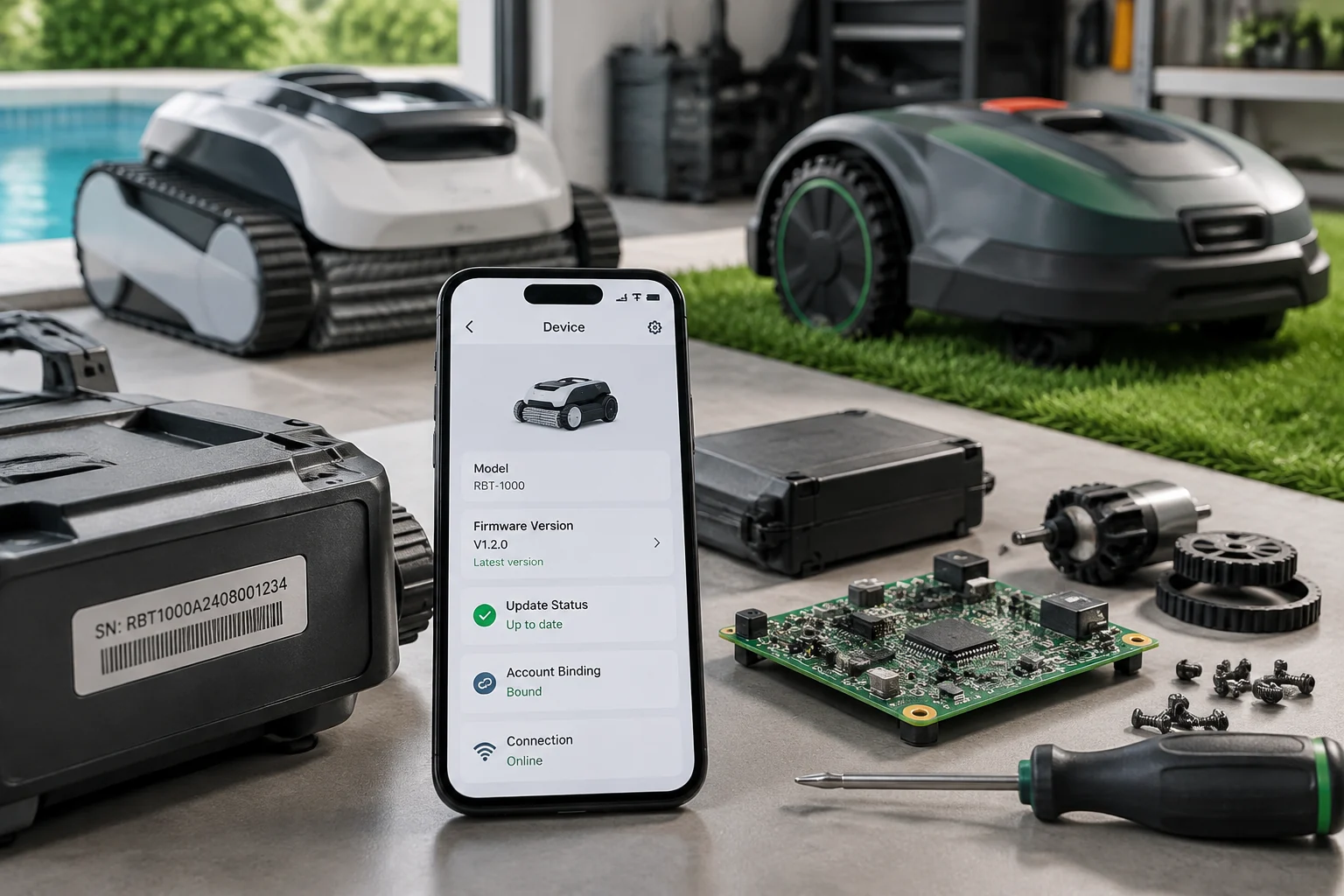
Account binding can become a practical problem for demo units, returns, dealer transfers and refurbished stock.
The BESTMOW T-100 product-limitations page says the device cannot be rebound to another account until the original owner unbinds it. Robomow’s support guidance tells a new owner to ask the previous owner to remove the robot from the account or contact customer service with proof of ownership. These are brand-specific procedures; they do not establish that all devices have the same restriction.
Before ordering, ask:
- Can the supplier release a bound device through an administrator account, or must the account holder do it?
- Is there a written transfer procedure and a stated handling time?
- Who clears the account binding for warranty returns and replacement units?
- What happens to maps, usage history and other user data during a transfer?
- If you change platform supplier under your own brand, how will existing customers continue using their devices?
The answers matter before you have a warehouse full of demo units or returns that cannot be activated by the next owner.
5. Spare-parts availability: ask for a list, not a promise
Do not treat “long-term support” as a spare-parts plan. Ask for actual part numbers, prices, lead times and a written availability commitment.
In the materials reviewed for this article, we did not identify a single EU-wide spare-parts availability period specifically covering robotic lawn mowers. That is a research finding, not a legal opinion or proof that no national or product-specific obligation can apply. Do not assume that a rule for another product group automatically applies to a mower or pool cleaner; confirm the position for your destination market with qualified counsel.
A practical first-order list can be divided into three layers:
- Wear parts and consumables — for example, mower blades, pool-cleaner brushes or filters, seals, wheels, tracks, charging contacts and power supplies. Ask which parts should be stocked and include the agreed quantities in the quotation.
- Replaceable modules — such as a drive motor, pump motor, main board, display or control panel, and dock electronics. Ask which modules a trained dealer can replace, with the correct part numbers and instructions.
- Board-level repair — an independent repair case from Mace Robotics documents a robotic mower motherboard fault traced to a MOSFET and repaired by replacing the component. This demonstrates that a board-level repair may be technically possible in a specific case; it does not prove that the manufacturer supports such repairs or that they remain warranty-compatible.
Request the spare-parts list with part numbers, unit prices, lead times and the agreed supply period. Also ask what happens when a part is discontinued: is there a last-time buy, an approved replacement, or a redesign that changes compatibility?
6. Technical support capacity: what can your dealer actually handle?
Technical support capacity is more than a promise to “provide support.” Before signing, establish the work your own team can perform and the cases that must go back to the factory.
- Diagnostics: Which fault codes can a dealer read without factory access? Which cases require a dedicated diagnostic device or remote access from the supplier?
- Documentation: Are service manuals, wiring diagrams, exploded views, calibration instructions and fault-code lists supplied?
- Training: Is training available remotely or on site? Is it included, paid, or limited to selected dealers?
- Escalation: Who does the technician contact, in what language, and what response commitment is written into the agreement?
- Repair scope: Which modules can be replaced locally, and which repairs must be performed by the factory or an authorised centre?
- Capacity planning: Estimate how many units one technician can realistically diagnose and repair each week, then compare that capacity with the installed base you expect to support.
This last calculation affects the business model. A product that regularly requires a factory return is different from one that a trained dealer can diagnose and repair locally.
7. Contract boundaries to settle before the deposit
For an OEM or white-label programme, put at least these points in writing:
- Software licence: Which apps and cloud services may your brand use or distribute, in which territories, for how long, and at what cost?
- Brand and customer account: Who controls the customer-facing account? Which company name appears in the app store, privacy notice and support channel?
- Service responsibility: Who responds to the end customer, who pays for parts and labour, and who manages returned units?
- Updates and compatibility: Who decides when an update is released, how is it communicated, and what happens if it changes performance or compatibility?
- Data and exit: Can relevant customer or device data be exported? At contract end, what rights and tools are available to support products already in the field?
- Parts and documentation: What happens to parts, diagnostic tools, service manuals and repair support if the supplier or platform relationship ends?
For EU-bound connected products, do not assume that a generic statement such as “CE compliant” answers every software and cybersecurity question. Ask qualified counsel to confirm the requirements that apply to the exact product, radio configuration and date it is placed on the market. Useful starting points are the European Commission’s Radio Equipment Directive guidance, Delegated Regulation (EU) 2022/30, Delegated Regulation (EU) 2026/339 and the Cyber Resilience Act, Regulation (EU) 2024/2847. Their scope and transition dates should be checked for the specific product and market.
None of these contract questions necessarily requires the supplier to hand over its source code. They require clarity on licence rights, operating control, support duration and the exit path.
For help assessing the supplier and sourcing arrangement alongside the product itself, see our sourcing services.
8. A pre-order checklist you can send to a supplier
Ask for written answers and supporting documents, not only verbal assurances.
- Confirm the control and ownership split for the device firmware, app, cloud service and data for this SKU.
- Describe what works with no internet connection and what happens when the cloud is unavailable.
- State the firmware version shipped for each SKU and the update method for each model.
- Provide the release-note or change-log process and the versions currently available.
- Explain whether maps and settings can be exported and what happens to them when an account is deleted or transferred.
- Provide the account transfer and unbinding procedure, including who can release a device and the expected handling time.
- Provide a spare-parts list with part numbers, prices, lead times, agreed availability period and discontinuation policy.
- Identify which modules can be replaced by a trained dealer and which repairs require factory support.
- Provide service documents, diagnostic-tool requirements and training options.
- Name the escalation contact, support languages, written response commitment and warranty labour policy.
- For OEM or white-label products, provide the software licence, territory, duration, fees and exit provisions.
- Identify the destination-market software and cybersecurity obligations that may apply, and specify who is responsible for meeting them.
9. How this changes the sourcing decision
A robotic product is more than the hardware in the carton. Its commercial life also depends on whether the product can be updated, diagnosed, repaired, transferred and supported after the first shipment.
If two quotations are close on hardware and cleaning or cutting performance, compare the written evidence behind their software, account, spares and service arrangements. Prefer the supplier whose answers are specific, model-based and supported by documents. If the answers are vague, record that uncertainty as a sourcing risk instead of treating a low unit price as the whole comparison.
For related checks, read our guides on evaluating a Chinese robotic pool-cleaner manufacturer, robotic lawn-mower pre-shipment inspection and FOB price versus total sourcing cost. Each addresses a different decision: supplier selection, shipment conformity and the cost of supporting the product.
Frequently asked questions
Is a robot mower app required to cut the lawn, and does it need Wi-Fi?
Not necessarily. Husqvarna documents continued scheduled operation for certain connected mower models when the mobile network connection is lost, but that is not proof of how every model behaves when all connectivity or the cloud service is unavailable. Verify the exact model.
What happens if a manufacturer shuts down its cloud service?
It depends on the product. Neato’s announcement about its robot vacuums said they would continue to function manually as cloud services were phased out. That is a cross-category example, not a prediction for a mower or pool cleaner. Ask the supplier which core functions remain and what happens to user data.
Who controls the firmware in a white-label product?
The answer depends on the contract and the platform arrangement. A platform supplier may provide the app, cloud and OTA functions while the brand manages sales and customer relationships. Confirm licence rights, duration, fees, update control and the exit plan.
Can a robotic product be transferred to a new owner account?
Some brands require the previous owner to unbind the device or require proof of ownership through support. Ask for the exact procedure for demo units, returns, replacement stock and refurbished products.
Is there a legal minimum period for spare-parts availability on robotic mowers?
The materials reviewed for this article did not establish a single EU-wide period specific to robotic mowers. That should not be treated as a definitive legal conclusion for every product or country. Confirm the rules for the destination market and write the agreed availability period into the supplier contract.
Want to assess the software and service side alongside the hardware? You can start a project or review our sourcing services.